An ABS board extrusion line converts acrylonitrile butadiene styrene resin into continuous, flat sheets for potential use in construction interiors and related applications. The line typically includes material feeding, melting, a flat die, cooling or calendering rolls, haul-off equipment, and a cutter. Each stage affects board thickness, surface finish, and dimensional consistency. Small details matter.
Market context is useful, but it needs careful interpretation. Grand View Research’s ABS Market Size, Share & Trends Analysis Report estimated the global ABS market at about US$29.15 billion in 2022 and projected a 5.1% compound annual growth rate from 2023 to 2030. That figure covers ABS applications broadly; it does not measure construction boards or extrusion-line sales specifically. It signals material-market scale, not guaranteed demand for a particular product.
For builders and manufacturers, the practical questions are more specific: Will the board meet the intended impact, stiffness, finish, and dimensional requirements? Can the line hold a stable profile during production? Resin grade, additives, die design, temperature settings, and cooling conditions all influence the result. A glossy sample is not proof of long-term performance. Outdoor exposure and application conditions need separate evaluation. Some details depend on the resin supplier, too. That deserves attention. This guide explains what an Abs Board Extrusion Line For Construction does, which equipment choices shape board quality, and what buyers should verify before investing. It also notes a limitation: published market reports rarely separate construction-grade ABS boards from the wider ABS market.
What an ABS Board Extrusion Line Is
What Is an ABS Board Extrusion Line for Construction?
What an ABS Board Extrusion Line Is
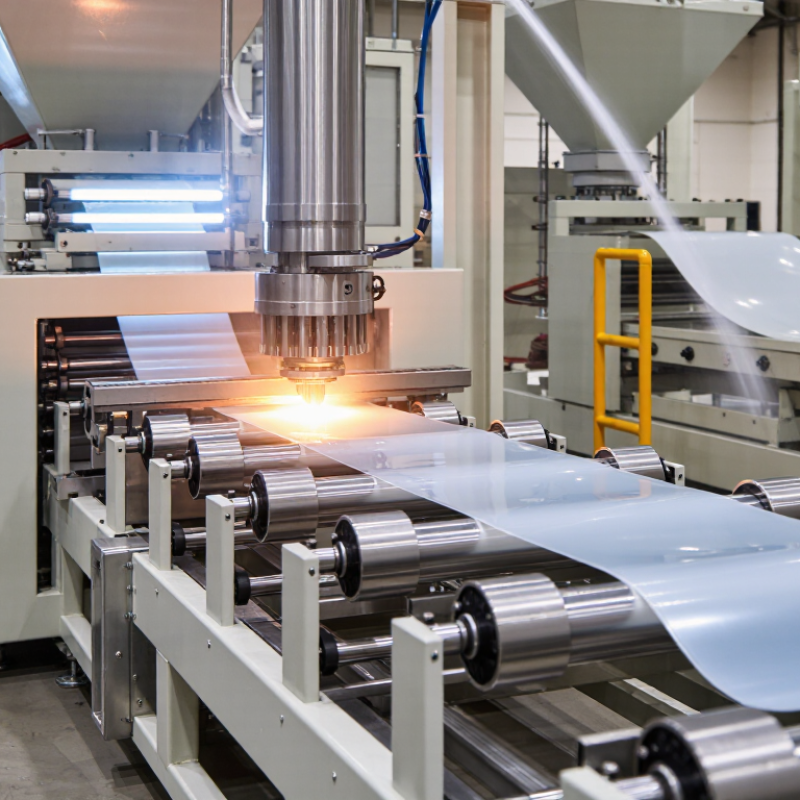
An ABS board extrusion line is a continuous system that turns acrylonitrile-butadiene-styrene pellets into flat plastic sheets. A heated barrel melts and mixes the pellets; a screw pushes the melt through a wide, flat die. Calender rolls set thickness and surface finish, while cooling, haul-off, and cutting equipment shape boards into usable lengths. That is the basic idea. In construction, these boards may serve as interior panels, protective linings, or fabricated components, depending on their formulation and intended use.
PlasticsEurope’s Plastics – the Fast Facts 2024 reports 413.8 million tonnes of global plastics production in 2023. This figure covers all plastics, not ABS board output, but it shows the scale of the material-processing sector. A line’s useful settings are more specific: melt temperature, screw speed, roll gap, and cooling rate affect flatness and thickness. Operators check cut edges and measure boards at several points, not just the center. A glossy surface can hide uneven gauge. It happens. ABS can be impact-resistant and easy to machine, yet outdoor durability depends on grade, additives, and exposure. Buyers should match line width, output, and calibration capacity to the board specification, then verify performance with trials; published capacity alone can mislead.
Materials and Main Components of the Production Line
An ABS board extrusion line converts thermoplastic pellets into continuous sheets used for selected construction and interior applications. The main material is acrylonitrile butadiene styrene resin, sometimes blended with colorants, impact modifiers, or processing additives. Each addition can affect color, stiffness, surface finish, and forming behavior. Recycled content may also be considered, but its consistency should be checked before production.
Moisture matters. Resin is commonly dried before entering the extruder, where a rotating screw melts and mixes it inside a heated barrel. A screen changer catches contaminants, while the die shapes the molten material into a flat sheet. Vacuum calibrators and cooling rollers help control thickness and surface appearance. Then, haul-off rolls pull the board forward, and a cutter trims it to length. A stacker collects the finished pieces. It is not always obvious. Small temperature or speed changes can leave visible marks or uneven edges. Operators need to check dimensions and surface quality during runs, not just at the end. The right settings depend on the resin blend, board thickness, and intended use. A clean finish alone does not confirm structural suitability.
ABS Board Extrusion Line: Typical Process Temperatures
ABS resin is dried before extrusion, then heated through the barrel and die to form a continuous board.
The chart shows illustrative setpoints: drying is commonly around 80–90°C, while ABS extrusion temperatures vary by grade, equipment, and board design. Main line components include a resin dryer, hopper and feeder, extruder, flat die, calibration unit, cooling system, haul-off, and cutter.
How ABS Boards Are Extruded Step by Step
What Is an ABS Board Extrusion Line for Construction?
How ABS Boards Are Extruded Step by Step
An ABS board extrusion line converts thermoplastic pellets into continuous, flat sheets for interior panels, equipment housings, and other construction uses. PlasticsEurope’s Plastics—The Fast Facts 2023 reported 400.3 million tonnes of global plastics production in 2022. That figure covers all plastics, not ABS alone, but shows the scale behind controlled processing.
The process begins with resin preparation. Operators dry ABS according to its grade requirements, then blend it with colorants or approved modifiers. Moisture can create bubbles or silver streaks. Small details matter. A heated screw conveys, melts, and mixes the material; screen packs help catch contaminants before the melt reaches a flat die. The die spreads it into a wide ribbon, where temperature and pressure balance affect thickness and surface quality.
Next, rollers or a calibrator set the board’s dimensions while cooling removes heat. A haul-off unit pulls the sheet at a steady speed, and downstream cutters trim it to length. Operators check thickness across the width, edges, and visible defects as production runs. If line speed rises too quickly, the sheet may cool unevenly or warp. That trade-off is easy to underestimate. Stable settings matter, but each formulation and board thickness still needs trial runs and recorded adjustments. The cited production statistic offers industry context, not a performance guarantee for any extrusion line.
Key Process Controls and Board Properties
An ABS board extrusion line turns dried pellets into a continuous sheet through melting, mixing, die shaping, and calibrated cooling.
Small control errors show up quickly: a wet feed can cause bubbles, while uneven die temperatures may leave one edge thicker. Track melt temperature, screw speed, die pressure, and haul-off speed together. A stable pressure trend matters more than a single “ideal” reading.
PlasticsEurope’s Plastics—The Fast Facts 2024 reports 413.8 million tonnes of global plastics production in 2023, a reminder that repeatable processing controls matter at scale. That figure is broad industry context, not an ABS-specific production measure.
For construction boards, thickness, flatness, impact behavior, and surface quality are practical acceptance checks.
Use a calibrated thickness gauge across the width, not only at the center. Test tensile properties using ISO 527 and flexural properties using ISO 178; report specimen conditioning and test direction, since extrusion can create directional variation.
Keep cooling rolls aligned and temperatures consistent. Watch for edge curl. It is easy to blame the die, though uneven cooling or excessive haul-off tension may be the real cause. Setpoints should be validated on the actual resin grade and board geometry; generic temperature windows are only starting points. A useful production record links each board sample to its melt conditions, line speed, and measured dimensions.
Construction Uses of Extruded ABS Boards
An ABS board extrusion line melts and shapes acrylonitrile butadiene styrene into continuous boards. In construction, those boards can serve as interior wall panels, cabinet components, trim, and protective covers. Their smooth surfaces are easy to wipe, and they can be cut to fit around outlets or corners. That helps in utility rooms, workshops, and other spaces where quick cleaning matters.
ABS boards are also useful for decorative wall finishes and lightweight partitions, provided the product specification suits the setting. A dense board may feel sturdy in hand, but that does not make it a structural panel. Check the manufacturer’s technical data for thickness, temperature limits, and fire performance before specifying it. The details matter. Installation needs care, too: leave room for thermal movement, and use compatible fasteners so edges do not crack.
On site, boards can protect finished surfaces during short-term work or provide a clean lining inside storage areas. Their moisture resistance can be helpful, but seams and cut edges still need attention in damp locations. Not for every job. Sunlight, heat, and repeated impact may affect performance, depending on the formulation and finish. A sample panel tested under actual site conditions can reveal issues that a brochure misses. That extra check is easy to overlook.
What Is an ABS Board Extrusion Line for Construction? - Construction Uses of Extruded ABS Boards
| Category |
Item or Use |
Typical Information |
Construction Relevance |
| Extrusion line |
Material preparation and feeding |
ABS pellets are dried when required by the material supplier and fed to the extruder. |
Appropriate material handling helps reduce moisture-related surface defects such as bubbles or splay. |
| Extrusion line |
Extruder and flat die |
The extruder melts and mixes the ABS; a flat die forms a continuous sheet or board. |
Die design and process settings influence sheet width, thickness, surface finish, and consistency. |
| Extrusion line |
Cooling, haul-off, and cutting |
Rollers or other calibration equipment control the sheet as it cools; haul-off and cutting equipment set its length. |
Stable cooling and take-off help produce flat boards with more consistent dimensions for fabrication and installation. |
| Typical material property |
Density |
Approximately 1.04–1.07 g/cm³ for many unfilled ABS grades; the exact value depends on grade and formulation. |
Useful for estimating panel weight, but the finished board’s mass also depends on its thickness and dimensions. |
| Typical material property |
Tensile strength |
Many general-purpose ABS grades are in the approximate range of 30–50 MPa; test method and grade affect results. |
This is a material test value, not a design rating for a finished panel or a guarantee of structural capacity. |
| Construction use |
Interior wall and ceiling panels |
Flat extruded boards can be cut, drilled, and mechanically fixed or bonded using a compatible system. |
Used as interior finish panels where a lightweight, impact-resistant plastic surface is suitable. Allow for fixing, support, and thermal movement. |
| Construction use |
Partitions and protective linings |
Boards can be fabricated into non-load-bearing partitions, protective covers, or equipment-room linings. |
Check required impact, fire, chemical, and cleaning performance for the intended location; ABS boards are not structural framing. |
| Construction use |
Formed panels and covers |
ABS sheet can be thermoformed into shaped covers, housings, and finishing components. |
Forming can create complex shapes for building services or interior fit-outs. Confirm that the selected grade suits the service temperature and environment. |
| Design consideration |
Exterior exposure |
Standard ABS may degrade or discolor under prolonged ultraviolet exposure unless the grade and protective measures are suitable. |
For outdoor use, verify UV and weathering performance with the supplier and consider a UV-stabilized grade or a protective surface system. |
| Design consideration |
Fire and temperature |
Fire behavior and heat resistance vary by ABS grade; ABS is a thermoplastic and softens when heated. |
Confirm applicable local fire requirements and service-temperature limits before specifying boards in a building assembly. |
Values are typical indicative ranges for general-purpose ABS, not product specifications. Actual properties, board dimensions, fire performance, and suitability depend on the grade, manufacturing conditions, installation details, and applicable building codes.
Conclusion
An Abs Board Extrusion Line For Construction is a production system that transforms ABS resin into durable boards for building and interior applications. The line typically includes material feeding and blending equipment, an extruder, a board-forming die, cooling and calibration units, a haul-off system, and cutting equipment. Depending on the required board characteristics, additives or compatible materials may be incorporated into the raw-material blend before processing.
Production begins with preparing and feeding the materials, followed by heating and melting them in the extruder. The melt is pushed through a die to create a continuous board profile, then cooled and calibrated to help achieve the desired dimensions and surface finish. Controls for temperature, extrusion speed, pressure, and cooling can influence board consistency, strength, and appearance. Once cut to size, extruded ABS boards may be used in construction for wall panels, protective surfaces, interior fittings, and other applications where a lightweight, impact-resistant, and easy-to-fabricate board is useful.